
Benign
- fibrocystic change: apocrine metaplasia, cyst, sclerosing adenosis, mammary fibrosis, etc.
- fibroadenoma
- hamartoma
- duct papilloma
- adenoma
- phyllodes
Malignant
- ductal carcinoma, DCIS, IDC
- lobular carcinoma, LCIS, ILC
- tubular carcinoma
- mucoid(colloid) carcinoma
- medullary carcinoma
--------------------------------------------------------
hyperplasia
- usual ( x 2)
- atypical ( x 5) => low grade DCIS (genetic alterations in chromosomes 16, 17)
high grade comes on its own (HER2 mutation)
papilloma - unilateral, bloody discharge, any age, myoepithelial and epithelial
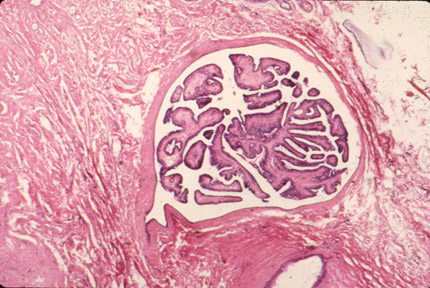
phyllodes(sarcoma) - stroma is the "malignant" component, epithelium benign

fibroadenoma - benign, epithelial tumor, composed of both epithelial and stromal components
grading - size, mitosis, nuclear atypia
lobular carcinoma - similar prognosis as ductal, but rise from lobules, E-cadherin gene inactivation found in LCIS
- more difficult to visualize than DCIS
- diffuse infiltrate
types of carcinoma with better prognosis
1) colloid(mucinous)
2) tubular
3) medullary - big lymphocytic infiltrate, cells pleomorphic
Peau d'orange

--------------------------------------------------------
HER2/neu (also known as ErbB-2) is a member of the epidermal growth factor receptor (ErbB) family and is notable for its role in the pathogenesis of breast cancer and as a target of treatment. It is a cell membrane surface-bound receptor tyrosine kinase and is normally involved in the signal transduction pathways leading to cell growth and differentiation. HER2 is thought to be an orphan receptor, with none of the EGF family of ligands able to activate it. However, ErbB receptors dimerise on ligand binding, and HER2 is the preferential dimerisation partner of other members of the ErbB family.[1] The HER2 gene is a proto-oncogene located at the long arm of human chromosome 17(17q11.2-q12).
Approximately 25-30 percent of breast cancers have an amplification of the HER2/neu gene or overexpression of its protein product. Overexpression of this receptor in breast cancer is associated with increased disease recurrence and worse prognosis. Because of its prognostic role as well as its ability to predict response to trastuzumab (see below), breast tumors are routinely checked for overexpression of HER2/neu. Overexpression also occurs in other cancer such as ovarian cancer and stomach cancer.
--------------------------------------------------------
ER(Estrogen receptors) are overexpressed in around 70% of breast cancer cases, referred to as "ER positive". Two hypotheses have been proposed to explain why this causes tumorigenesis, and evidence supports a combination of both:
- Firstly, binding of estrogen to the ER stimulates proliferation of mammary cells, with the resulting increase in cell division and DNA replication leading to mutations.
- Secondly, estrogen metabolism produces genotoxic waste.
The result of both processes is disruption of cycle cycle, apoptosis and DNA repair and therefore tumour formation. ERα is certainly associated with more differentiated tumours, while evidence that ERβ is involved is controversial. Different versions of the ESR1 gene have been identified (with single-nucleotide polymorphisms) and are associated with different risks of developing breast cancer.[7]
Endocrine therapy for breast cancer involves selective estrogen receptor modulators (SERMS) which behave as ER antagonists in breast tissue or aromatase inhibitors. ER status is used to determine sensitivity of breast cancer lesions to tamoxifen and aromatase inhibitors[12]. Another SERM, raloxifene, has been used as a preventative chemotherapy for women judged to have a high risk of developing breast cancer[13] Another chemotheraputic anti-estrogen, ICI 182,780 (Faslodex) which acts as a complete antagonist also promotes degradation of the estrogen receptor.
Estrogen and the ERs have also been implicated in ovarian cancer, colon cancer, prostate cancer and endometrial cancer. Advanced colon cancer is associated with a loss of ERβ, the predominant ER in colon tissue, and colon cancer is treated with ERβ specific agonists [14].
The two different estrogen receptor proteins produced from the ESR1 and ESR2 genes are usually called the α and β receptors. The estrogen receptors form dimers, and there the two different receptor subtypes can form mixed dimers in the presence of ligands. Hence, there are three combinations: ERα (αα), ERβ (ββ) and ERαβ (αβ)[3]. Different tissues express the subtypes in different proportions, and therefore have different responses to stimulation.Both receptors show some overall homology, and are composed of seven domains (listed from N- to C-; numbers refer to human ER, and may vary):

--------------------------------------------------------
 | |
| Tamoxifen | |
| Systematic (IUPAC) name | |
| (Z)-2-[4-(1,2-diphenylbut-1-enyl)phenoxy]-N,N-dimethyl-ethanamine | |
| Identifiers | |
| CAS number | |
| ATC code | L02 |
| PubChem | |
| DrugBank | |
| Chemical data | |
| Formula | C26H29NO |
| Mol. mass | 371.515 g/mol 563.638 g/mol (citrate salt) |
| Pharmacokinetic data | |
| Bioavailability | ? |
| Metabolism | Hepatic (CYP3A4, 2C9 and 2D6) |
| Half life | 5-7 days |
| Excretion | Fecal |
Breast cancer treatment
It is used for the treatment of early and advanced estrogen receptor (ER) positive breast cancer in pre- and post-menopausal women. It is also approved by the Food and Drug Administration (FDA) for the reduction of the incidence of breast cancer in women at high risk of developing the disease. It has been further approved for the reduction of contralateral (in the opposite breast) breast cancer.
Nolvadex was first approved by the FDA on December 30, 1977 for treatment of metastatic breast cancer. It is also available as a generic drug in a number of countries.
On April 17, 2006, it was announced that raloxifene is equally effective in reducing the incidence of breast cancer, but caused fewer side effects.
Side effects
Tamoxifen is a selective estrogen receptor modulator. Even though it is an antagonist in breast tissue it acts as partial agonist on the endometrium and has been linked to endometrial cancer in some women. Therefore endometrial changes, including cancer, are among tamoxifen's side effects.[3]
For some women, tamoxifen can cause a rapid increase in triglyceride concentration in the blood. In addition there is an increased risk of thromboembolism especially during and immediately after major surgery or periods of immobility.
