- firmly adherent to the dura that indent the surface of the brain but rarely invade it.
- They are usually firm solid tumors, often with a gritty texture.
- A whorl-like pattern may be detectable on their cut surfaces.
- Hyperostosis of the bone overlying a meningioma is common.


--------------------------------------------------------
Hyperostosis is an excessive growth of bone. It may lead to exostosis.
An exostosis (plural: exostoses) is the formation of new bone on the surface of a bone. Exostosis can cause chronic pain ranging from mild to debilitatingly severe, depending on where they are located and what shape they are.
--------------------------------------------------------
Graves disease is a thyroid disorder characterized by goiter, exophthalmos, "orange-peel" skin, and hyperthyroidism.
Pathophysiology
Graves' disease is an autoimmune disorder, in which the body produces antibodies to the receptor for thyroid-stimulating hormone (TSH). (Antibodies to thyroglobulin and to the thyroid hormones T3 and T4 may also be produced.)
These antibodies cause hyperthyroidism because they bind to the TSH receptor and chronically stimulate it. The TSH receptor is expressed on the follicular cells of the thyroid gland (the cells that produce thyroid hormone), and the result of chronic stimulation is an abnormally high production of T3 and T4. This in turn causes the clinical symptoms of hyperthyroidism, and the enlargement of the thyroid gland visible as goiter.
The infiltrative exophthalmos that is frequently encountered has been explained by postulating that the thyroid gland and the extraocular muscles share a common antigen which is recognized by the antibodies. Antibodies binding to the extraocular muscles would cause swelling behind the eyeball.
The "orange peel" skin has been explained by the infiltration of antibodies under the skin, causing an inflammatory reaction and subsequent fibrous plaques.
There are 3 types of autoantibodies to the TSH receptor currently recognized:
- TSI, Thyroid stimulating immunoglobulins: these antibodies (mainly IgG) act as LATS (Long Acting Thyroid Stimulants), activating the cells in a longer and slower way than TSH, leading to an elevated production of thyroid hormone.
- TGI, Thyroid growth immunoglobulins: these antibodies bind directly to the TSH receptor and have been implicated in the growth of thyroid follicles.
- TBII, Thyrotrophin Binding-Inhibiting Inmunoglobulins: these antibodies inhibit the normal union of TSH with its receptor. Some will actually act as if TSH itself is binding to its receptor, thus inducing thyroid function. Other types may not stimulate the thyroid gland, but will prevent TSI and TSH from binding to and stimulating the receptor.
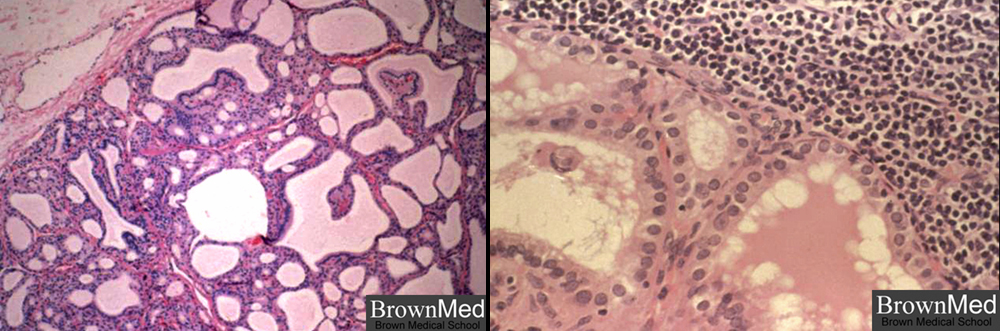
Histology of Graves' disease
- small lumen empty no colloid
- excessive cellularity of parenchyma
- increase in height of the lining epithelium to form tall columnar cells
- increase in number of cells => pile up in papillary buds and encroach on the colloid
- colloid markedly diminished and if present has a thin pale pink watery appearance
--------------------------------------------------------
Sarcomatoid urothelial carcinoma


Sarcomatoid carcinoma of the renal pelvis showing cluster of atypical epithelial cells surrounded by spindle cell proliferation.
