US as sensitve as CXR in this case
aortic dissection
if the rupture between intima and media => dissection, usually due to HTN
if the rupture between media and adventitia => transection, usually due to trauma
---------------------------------------------------------------------------
penetrating neck trauma
neck zone I and III difficult to access surgically

----------------------------------------------------------------------------
Focused abdominal ultrasound for trauma, commonly abbreviated as FAST and also known as focused assessment with sonography for trauma, is a rapid, bedside, ultrasound examination performed by surgeons and emergency physicians to screen for significant hemoperitoneum or pericardial tamponade after trauma.
The four areas that are examined for free fluid are the perihepatic (hepato-renal space), perisplenic space, pericardium, and the pelvis. With this technique it is possible to identify the presence of free intraperitoneal or pericardial fluid, which in the context of traumatic injury, is usually due to bleeding.
Interpretation
In hemodynamically unstable patients, a positive FAST result suggests hemoperitoneum and laparotomy should be performed in most cases. In hemodynamically unstable patients with a negative FAST result, a search for extra-abdominal sources of bleeding should be performed. In hemodynamically stable patients, a positive FAST result should be followed by a CT scan to better define the nature of the injuries.[2]
---------------------------------------------------------------------------trauma injury to liver usually elevates amylase, LFT(liver function test) and AST
Aspartate transaminase (AST)
Aspartate transaminase (AST) also called Serum Glutamic Oxaloacetic Transaminase (SGOT) or aspartate aminotransferase (ASAT) is similar to ALT in that it is another enzyme associated with liver parenchymal cells. It is raised in acute liver damage, but is also present in red cells, and cardiac and skeletal muscle and is therefore not specific to the liver. The ratio of AST to ALT is sometimes useful in differentiating between causes of liver damage:
- ALT>AST: acute viral hepatitis, drug-induced hepatitis or Non-alcoholic fatty liver disease
- ALT
In resource-poor settings, the AST is more frequently available than the ALT, because it is a cheaper assay. The reference range is 0-45 U/L in most laboratories.
---------------------------------------------------------------------------CBC, HMH?
---------------------------------------------------------------------------
Pancreatic ascites, which is characterized by a very high amylase in the ascitic fluid (greater than 1000 IU/L) and high protein concentration, most commonly presents with increased abdominal girth, along with abdominal discomfort. Severe abdominal pain is uncommon. Weight loss is a common symptom despite the increased abdominal girth and distention. It is 2-3 times more common in men and most commonly presents between the age of 20 and 50.
A history of chronic pancreatitis is common, as this is the etiology of the pancreatic ascites in approximately 80% of cases (1,2). Gomez-Cerezo et al.(1) recently reviewed 139 cases reported in the literature between 1975 and 2000. Chronic pancreatitis was the underlying disorder in 83%, acute pancreatitis in 8.6%, and trauma in 3.6%. Other reported causes include cystic duplication of the biliopancreatic ducts, ampullary stenosis, or stone disease. Alcohol is the most common etiology of the pancreatic disease, occuring in 92 of the 139 patients in the study described above(1). Although chronic pancreatitis is the most common underlying disorder, pancreatic ascites only occurs in approximately 3.5% of patients with chronic pancreatitis and 6-14% of patients with a known pancreatic pseudocyst(3).
---------------------------------------------------------------------------AKA(above knee amputation)
extra anatomic bypass(AXF)
- axillofemoral bypass graft - graft not in a normal vascular path; usually, the graft goes from the axillary artery to the femoral artery and then from one femoral artery to the other(fem-fem bypass)
---------------------------------------------------------------------------
In medicine, flash pulmonary edema (FPE), is rapid onset pulmonary edema. It is most often precipitated by acute myocardial infarction or mitral regurgitation, but can be caused by aortic regurgitation, heart failure, or almost any cause of elevated left ventricular filling pressures. Failure of heart to remove fluid from pulmonary circulation Treatment of FPE should be directed at the underlying cause, but the mainstays are ensuring adequate oxygenation, diuresis, and decrease of pulmonary circulation pressures.
Reoccurrence of FPE is thought to be associated with hypertension[1] and may signify renal artery stenosis.[2] Prevention of reoccurrence is based on managing hypertension, coronary artery disease, renovascular hypertension, and heart failure.
----------------------------------------------------------------------------moderate LVH, diffuse luminal irregularity of LAD
thrombectomy x 2
----------------------------------------------------------------------------
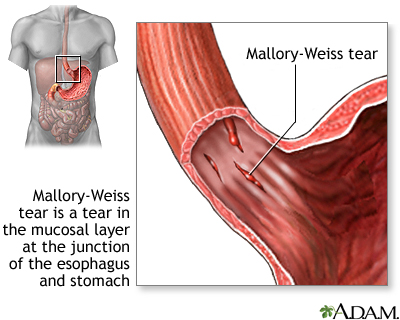
A Mallory-Weiss tear occurs in the mucous membrane where the esophagus connects to the stomach. The tear causes bleeding.
Causes, incidence, and risk factors Return to top
Mallory-Weiss tears are usually caused by forceful or long-term vomiting or coughing. They may also be caused by epileptic convulsions.
The tear may be followed by vomiting bright red blood or by passing blood in the stool. Any condition that leads to violent and lengthy bouts of coughing or vomiting can cause these tears.
The incidence is 4 in 100,000 people.
Symptoms Return to top
- Vomiting blood (bright red)
- Bloody stools
Signs and tests Return to top
- EGD (esophagogastroduodenoscopy) showing a tear with bleeding
- CBC possibly showing low hematocrit
Treatment Return to top
The tear usually heals in about 10 days without special treatment. Surgery is rarely required. Prescription antacids (proton pump inhibitors or H2 blockers) may be given.
If blood loss has been great, blood transfusions may be necessary. Excessive bleeding may need to be treated by using an endoscope (see EGD). In most cases, bleeding stops without specific treatment within a few hours.
----------------------------------------------------------------------------hyperlipidemia
liver lock
cystogram
betadiene
phenytoin
lisinopril
MVC
G-tube contrast, diatrizoate meglumine gastroview
----------------------------------------------------------------------------
In emergency medicine, a GI cocktail (gastrointestinal involvement cocktail) is a generic term for a mixture of liquid antacid, viscous lidocaine, and an anticholinergic to treat esophagitis.
A common type includes a mixtures of Maalox, Donnatal, and Xylocaine.
Many different combinations of GI cocktails are used, however, there is much dispute in recent research as to what is the best approach. Some researchers have found that many GI cocktails may not be as effective as one antiacid.
----------------------------------------------------------------------------C-spine
