Beta blockers(decrease AV conduction)
- selective: esmolol, atenolol, metoprolol => ema (treat performance anxiety)
- non-selective: propranolol, pindolol, sotalol, timolol
Cardiac drugs with both beta and alpha properties(considered part of beta blocker)
carvedilol, labetalol may,
- increase contracility and stimulation
- decrease contratility and destimulation
nonselective and selective, has safety margin
Cardiac glycosides(increase heart contractility)
- digoxin, digitoxin
anti-arrhythmic
Sodium Channel Blockers (Class I)
- Class IA
- quinidine (Quinidex)
- procainamide (Pronestyl)
- disopyramide (Norpace)
- Class IB
- lidocaine (Xylocaine)
- tocainide (Tonocard)
- mexiletine (Mexitil)
- Class IC
- encainide (Enkaid)
- flecainide (Tambocor)
Beta-Adrenergic Blockers (Class II)
- propranolol (Inderal)
- Acebutolol (Sectral)
- Esmolol (Brevibloc)
- sotalol (Betapace)
Drugs that Prolong Repolarization (Class III)
- sotalol (Betapace)
- amiodarone (Cordarone)
Calcium Channel Blockers (Class IV)
Miscellaneous
Diuretics(for congested heart failure)
- adenosine (Adenocard)
- digoxin (Lanoxin)
- hydrochlorothiazide, works in distal convoluted tubule(DCT), blocks Na+/Cl- channel
- furosemide - works in thick ascending loop of Henle, inhibit Na+/K+ 2Cl- pump, used for pt with hypercalcemia, may have sulfur allergy
- spironolactone - danger of hyperkalemia
--------------------------------------------------------------------------
--------------------------------------------------------------------------
Cardiac glycoside
Structure
Cardiac glycosides are composed of two structural features : the sugar (glycoside) and the non-sugar (aglycone - steroid) moieties. (figure below)
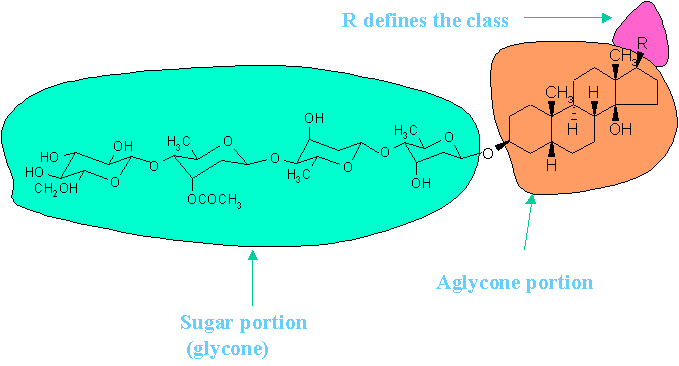
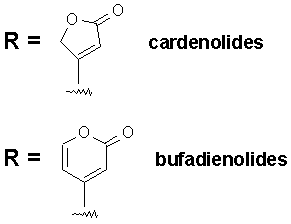
The R group at the 17-position defines the class of cardiac glycoside. Two classes have been observed in Nature - the cardenolides and the bufadienolides (see figure below). The cardenolides have an unsaturated butyrolactone ring while the bufadienolides have an a-pyrone ring.
The commercially available cardiac steroids differ markedly in their degree of absorption, half-life, and the time to maximal effect (see table below).
| Agent | GI absorption | Onset (m) | Peak (h) | Half-life |
| Ouabain | Unreliable | 5-10 | 0.5-2 | 21 h |
| Deslanoside | Unreliable | 10-30 | 1-2 | 33 h |
| Digoxin | 55-75% | 15-30 | 1.5-5 | 36 h |
| Digitoxin | 90-100% | 25-120 | 4-12 | 4-6 days |
Cardiac glycosides work by inhibiting the Na+/K+ pump. They do this by stabilizing the E2-P transition state of the Na+/K+ pump. This inhibition increases the amount of Ca++ ions available for contraction of the heart muscle, improves cardiac output and reduces distention of the heart.
They have an antiarrhythmic effect by prolonging the refractory period of the AV node (Atrioventricular node), reducing the number of impulses reaching the ventricles. Cardiac output is restored but atrial fibrillation or atrial flutter are not abolished.
--------------------------------------------------------------------------
Antiarrhythmic agents are a group of pharmaceuticals that are used to suppress fast rhythms of the heart (cardiac arrhythmias), such as atrial fibrillation, atrial flutter, ventricular tachycardia, and ventricular fibrillation.
Vaughan Williams antiarrhythmic classification
The Vaughan Williams classification is one of the most widely used classification schemes for antiarrhythmic agents. This scheme classifies a drug based on the primary mechanism of its antiarrhythmic effect. However, its dependence on primary mechanism is one of the limitations of the VW classification, since many antiarrhythmic agents have multiple action mechanisms. Amiodarone, for example, has effects consistent with all of the first four classes. Another limitation is the lack of consideration within the VW classification system for the effects of drug metabolites. Procainamide—a class Ia agent whose metabolite N-acetyl procainamide (NAPA) has a class III action—is one such example. A historical limitation was that drugs such as digoxin and adenosine – important antiarrhythmic agents – had no place at all in the VW classification system. This has since been rectified by the inclusion of class V.
There are five main classes in the Vaughan Williams classification of antiarrhythmic agents:
- Class I agents interfere with the sodium (Na+) channel.
- Class II agents are anti-sympathetic nervous system agents. All agents in this class are beta blockers.
- Class III agents affect potassium (K+) efflux.
- Class IV agents affect the AV node.
- Class V agents work by other or unknown mechanisms.
[edit] Class I agents
The class I antiarrhythmic agents interfere with the sodium (Na+) channel. Class I agents are grouped by what effect they have on the Na+ channel, and what effect they have on cardiac action potentials.
[edit] Class Ia agents

Class Ia agents block the fast sodium channel. Blocking this channel depresses the phase 0 depolarization (reduces Vmax), which prolongs the action potential duration by slowing conduction. Agents in this class also cause decreased conductivity and increased refractoriness.
Indications for Class Ia agents are supraventricular tachycardia, ventricular tachycardia, symptomatic ventricular premature beats, and prevention of ventricular fibrillation.
Procainamide can be used in the treatment of atrial fibrillation in the setting of Wolff-Parkinson-White syndrome, and in the treatment of wide complex hemodynamically stable tachycardias.
While procainamide and quinidine may be used in the conversion of atrial fibrillation to normal sinus rhythm, they should only be used in conjunction with an AV node blocking agent (ie: digoxin, verapamil, or a beta blocker), because procainamide and quinidine can increase the conduction through the AV node and may cause 1:1 conduction of atrial fibrillation, causing an increase in the ventricular rate.
Class Ia agents include quinidine, procainamide and disopyramide.
[edit] Class Ib agents

Class Ib antiarrhythmic agents are sodium channel blockers. Class Ib agents have fast onset and offset kinetics, meaning that they have little or no effect at slower heart rates, and more effects at faster heart rates. Class Ib agents shorten the action potential duration and reduce refractoriness. These agents will decrease Vmax in partially depolarized cells with fast response action potentials. They either do not change the action potential duration, or they may decrease the action potential duration.
Class Ib agents are indicated for the treatment of ventricular tachycardia and symptomatic premature ventricular beats, and prevention of ventricular fibrillation.
Class Ib agents include lidocaine, mexiletine, tocainide, and phenytoin.
[edit] Class Ic agents

Class Ic antiarrhythmic agents markedly depress the phase 0 depolarization (decreasing Vmax). They decrease conductivity, but have a minimal effect on the action potential duration. Of the sodium channel blocking antiarrhythmic agents (the class I antiarrhythmic agents), the class Ic agents have the most potent sodium channel blocking effects.
Class Ic agents are indicated for life-threatening ventricular tachycardia or ventricular fibrillation, and for the treatment of refractory supraventricular tachycardia (ie: atrial fibrillation).It can be toxic and can affect the reproductive system.
Class Ic agents include encainide, flecainide, moricizine, and propafenone.
[edit] Class II agents
Class II agents are conventional beta blockers. They act by selectively blocking the effects of catecholamines at the β1-adrenergic receptors, thereby decreasing sympathetic activity on the heart. These agents are particularly useful in the treatment of supraventricular tachycardias. They decrease conduction through the AV node.
Class II agents include esmolol, propranolol, and metoprolol.
[edit] Class III agents

Class III agents predominantly block the potassium channels, thereby prolonging repolarization.[5] Since these agents do not affect the sodium channel, conduction velocity is not decreased. The prolongation of the action potential duration and refractory period, combined with the maintenance of normal conduction velocity, prevent re-entrant arrhythmias. (The re-entrant rhythm is more like to interact with tissue that has become refractory).
Class III antiarrhythmic agents exhibit reverse use dependent prolongation of the action potential duration (Reverse use-dependence). This means that the refractoriness of the ventricular myocyte increases at lower heart rates. This increases the susceptibility of the myocardium to early after-depolarizations (EADs) at low heart rates. Antiarrhythmic agents that exhibit reverse use-dependence are more efficacious at preventing a tachyarrhythmia than converting someone into normal sinus rhythm. Because of the reverse use-dependence of class III agents, at low heart rates class III antiarrhythmic agents may paradoxically be more arrhythmogenic.
Amiodarone is indicated for the treatment of refractory VT or VF, particularly in the setting of acute ischemia. Amiodarone is also safe to use in individuals with cardiomyopathy and atrial fibrillation, to maintain normal sinus rhythm.
Sotalol is indicated for the treatment of atrial or ventricular tachyarrhythmias, and AV re-entrant arrhythmias. Ibutilide is the only antiarrhythmic agent currently approved by the Food and Drug Administration for acute conversion of atrial fibrillation to sinus rhythm.
Class III agents include amiodarone, azimilide, bretylium, clofilium, dofetilide, tedisamil, ibutilide, sematilide, and sotalol.
[edit] Class IV agents
Class IV agents are slow calcium channel blockers. They decrease conduction through the AV node.
Class IV agents include verapamil and diltiazem.
[edit] Class V agents
Class V agents include adenosine and digoxin. Digoxin increases vagal activity via its central action on the central nervous system, thus decreasing the conduction of electrical impulses through the AV node
--------------------------------------------------------------------------A diuretic (colloquially called a water pill) is any drug or herb that elevates the rate of bodily urine excretion (diuresis). Diuretics also decrease the extracellular fluid (ECF) volume, and are primarily used to produce a negative extracellular fluid balance. Caffeine, Yerba mate, cranberry juice and alcohol are all weak diuretics.
[edit] Uses
In medicine, diuretics are used to treat heart failure, liver cirrhosis, hypertension and certain kidney diseases. Diuretics alleviate the symptoms of these diseases by causing sodium and water loss through the urine. As urine is produced by the kidney, sodium and water – which cause edema related to the disease – move into the blood to replace the volume lost as urine, thereby reducing the pathological edema. Some diuretics, such as acetazolamide, help to make the urine more alkaline and are helpful in increasing excretion of substances such as aspirin in cases of overdose or poisoning. Diuretics are often abused by sufferers of eating disorders, especially bulimics as a weight loss attempt.
The antihypertensive actions of some diuretics (thiazides and loop diuretics in particular) are independent of their diuretic effect. That is, the reduction in blood pressure is not due to decreased blood volume resulting from increased urine production, but occurs through other mechanisms and at lower doses than that required to produce diuresis. Indapamide was specifically designed with this is mind, and has a larger therapeutic window for hypertension (without pronounced diuresis) than most other diuretics.
[edit] Mechanism of action
Chemically, diuretics are a diverse group of compounds that either stimulate or inhibit various hormones that naturally occur in the body to regulate urine production by the kidneys.
Alcohol produces diuresis through modulation of the vasopressin system.
